Katuchef: Australians may be eating a credit card’s worth of plastic a week, and scientists now say one everyday kitchen object could be a hidden source
With katuchef you don’t need to panic. But after the Newcastle research made headlines, food scientists took a closer look at the humble plastic chopping board, and what they found is quietly changing what a lot of careful home cooks keep on their bench.
By Marissa F. | Published 1 August 2026
You probably saw the headline. Researchers at the University of Newcastle, in a study commissioned by the WWF, estimated that the average person may be ingesting about a credit card’s worth of plastic every week,
roughly five grams. It made the news right across Australia, and most of us had the same reaction: where on earth is it all coming from?
Bottled water. Salt. Seafood. We’ve heard those. But scientists have now flagged one source that almost nobody suspected, sitting on the bench in nearly every Australian kitchen.
Your plastic chopping board.
In 2023, a team publishing in the American Chemical Society journal Environmental Science & Technology measured what actually comes off a plastic board as you chop. Their finding: a single board can
shed somewhere between 14 and 71 million microplastic particles a year. Put in plain terms, that’s around 50 grams, about ten credit cards of plastic a year, scraped off your chopping board and straight into your dinner.
There’s a graphic phrase that keeps coming up on kitchen forums, and it stuck with us: “I prefer to avoid eating plastic when I can feasibly avoid it.” Fair enough.
Why an old board is worse than you think
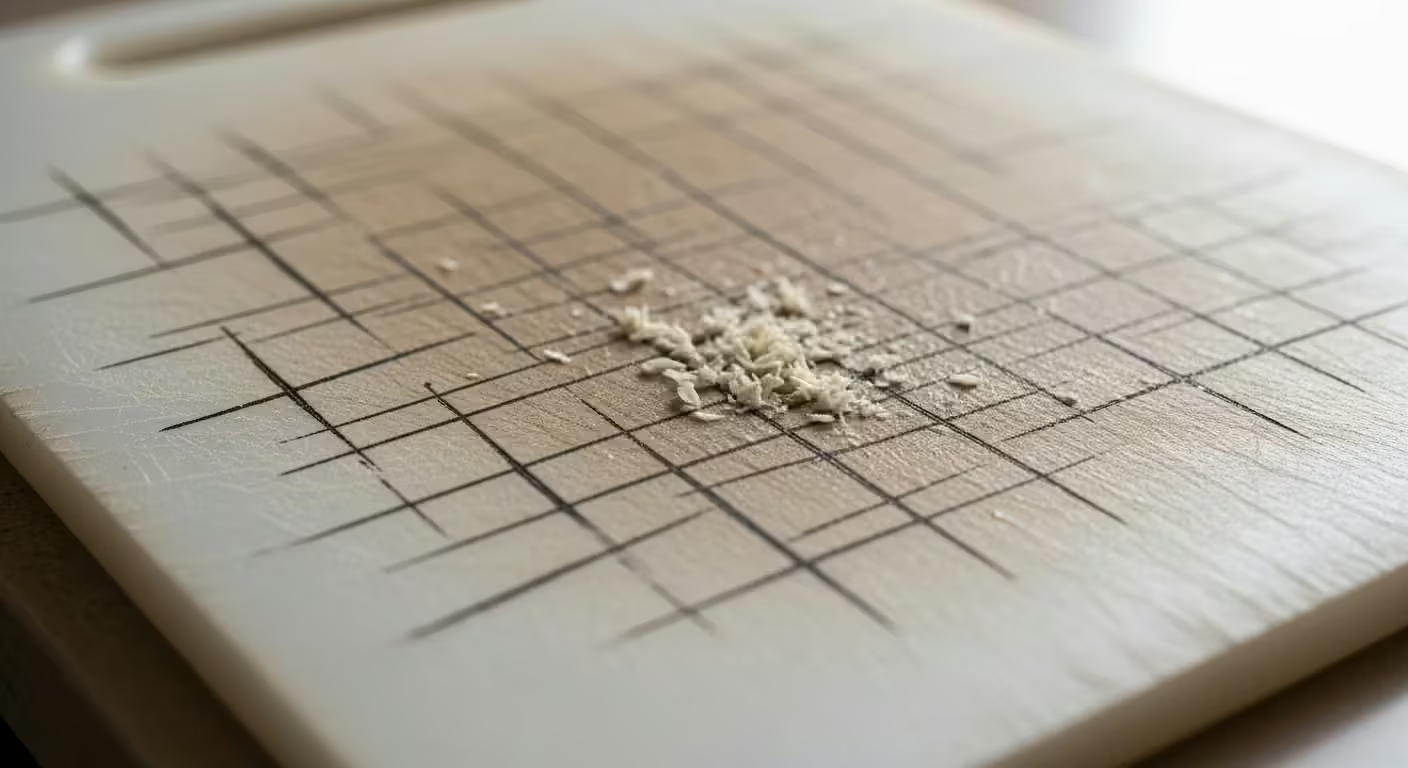
Every stroke of the knife scores the surface
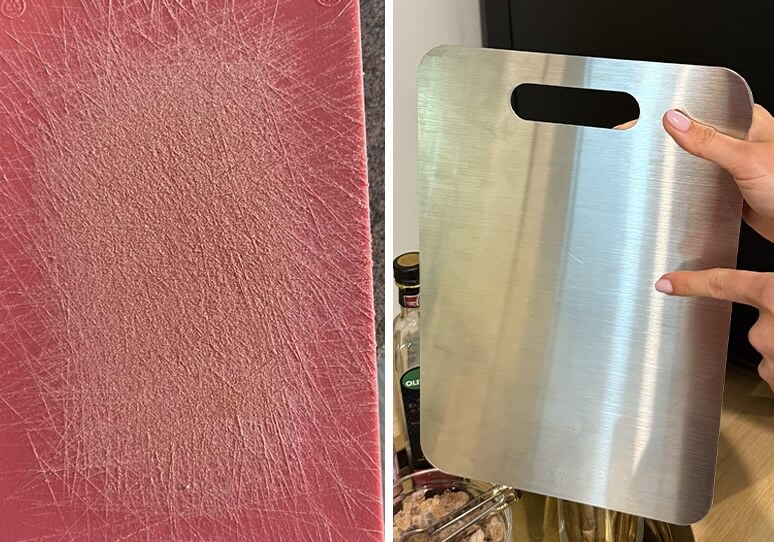
A brand-new board is smooth. But each cut leaves a tiny groove, and over months those grooves multiply into thousands of fine cut marks. As one home cook put it after inspecting her heavily used boards: “Every one was clearly missing material. It’s going somewhere, and it’s going into the food.” With plastic, what’s missing is plastic.
Those grooves become a place germs can hide
Meat juices, moisture and food residue settle down into the fine cut marks, and once a board is scored, that surface is very hard to fully sterilise. As people describe it in their own words: “the meat juices get into the pores… it can’t be sterilised.” A quick rinse simply doesn’t reach where the problem lives.
And the odour that never quite leaves
Anyone who’s cut a lot of garlic, onion or raw meat on the same board knows the feeling: “the smell doesn’t leave, no matter how well you scrub, a little bit is always there.” Salt and lemon, baking
soda, a vinegar soak, people try everything, and the board still carries it. That lingering odour is coming from residue trapped in a porous, scored surface.
Where does it all end up?
Not on the bench. It ends up in whatever you’re cutting, the fruit for the grandkids, the veg, the Sunday roast. Which is exactly why so many careful cooks, once they read the research, quietly decided the old board had to
go.
The catch: swapping to “natural” doesn’t solve it
A fresh plastic board buys you a few weeks, then it’s scored and shedding again.
Timber and bamboo look reassuringly natural, but they’re porous too. They soak up moisture and juices, they can crack, and a wet wooden board that never fully dries is its own hygiene headache. (In the same lab tests, wood
actually shed more particles than plastic, the difference being those are wood fibres, not plastic.)
So you’re left going in circles: board to board, scrubbing more, worrying more, while the core problem of a porous, scored surface shedding into your food never actually goes
away.
Why a GP actually recommends Katuchef board?
Dr. Sarah M., a Sydney GP, has fielded plenty of worried questions about microplastics since the Newcastle study. She now recommends a non-porous board like KatuChef.
We put the question to Dr. Sarah M., a Sydney GP, who has fielded plenty of worried questions about microplastics from her patients since the Newcastle study broke.
“I tell people the same thing I tell myself,” she says. “Don’t panic, but do the easy things. You can’t control the plastic in bottled water or the ocean. You can control what you chop your family’s food
on. A worn plastic board is one of the few sources that’s completely within your power to remove, and it’s a five-minute swap.”
Her practical advice lines up with the “safer board” guidance you’ll see from consumer groups: the goal is a surface that’s genuinely non-porous, one with no grooves for bacteria to settle into, and one
that doesn’t shed plastic into your food as you use it. That’s a short list of materials, and it’s where titanium keeps coming up.
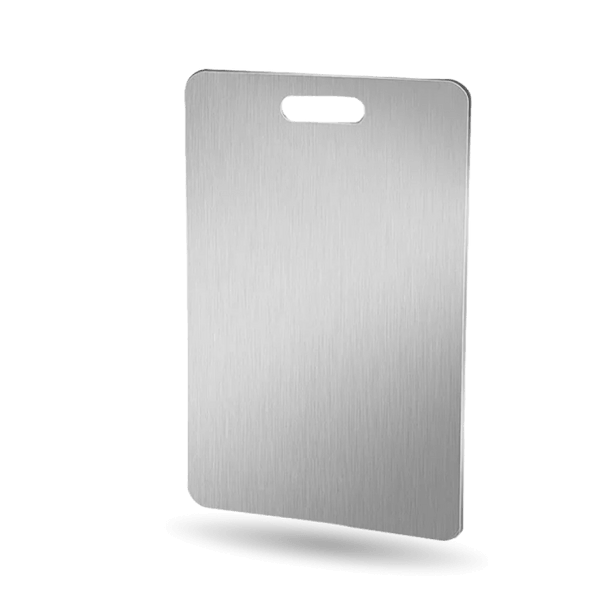
Which brings us to KatuChef, the titanium cutting board.
Below, we look at why the same material used in surgical tools and professional kitchens has become the quiet upgrade for Australian families who read the research and decided they’d rather not keep eating their chopping board.
What makes KatuChef so special?
The “secret” of KatuChef lies not in any coating, but in the material itself: pure titanium, a metal that is also used in medical technology and professional kitchens.
Non-porous surface: Titanium is extremely smooth and doesn’t absorb liquid, there are no micro-cracks or grooves where meat juices, bacteria or colour can become trapped.
Sheds no microplastics: Unlike plastic or coated wood, a titanium surface doesn’t flake particles into your food as you chop, no matter how often you use it.
Nothing for odour to cling to: Because the surface is sealed and non-porous, that garlic-and-onion smell has nowhere to soak in. A rinse, and it’s gone.
Built to last: Titanium won’t warp, stain, crack or peel the way plastic, timber and coated boards eventually do, so one board can replace the drawer full you keep rotating.
Cleaning in seconds: Thanks to the hard, smooth surface, hot water and a little washing-up liquid are usually all it takes, after that, it’s hygienically clean again.
In short: instead of scoring grooves that trap germs and shedding plastic into your dinner, you’re chopping on a stable, non-porous titanium surface that’s made to last.
So what actually changes when you swap?
KatuChef is made from 100% pure titanium, no coatings, no plasticisers, no BPA, nothing that can leach out. So there is nothing to end up in the fruit you cut for the
grandkids or the veg for the Sunday roast.
You can cut anything on KatuChef:
✅ Fruit and veg for the grandkids
✅ Meat, fish & poultry
✅ Bread, cheese and deli meats
✅ Onions, garlic & strongly colouring foods
Titanium is taste-neutral, does not react with acids (e.g., lemon, tomato) and does not release any substances into food. The smooth, non-porous surface is easy to clean with hot water and a little dish
soap, no special cleaning agents, no scrubbing, no worries about microplastics or peeling paint.
The result:
No harmful residues from the board in your food, fewer germs, and a cutting board that can be used every day with confidence, even in sensitive family kitchens.
Katuchef Board Reviews
"I’m 67 and I’ve cut on plastic and wooden boards my whole life, scratched, gone grey, just looked used. When I saw that report about plastic coming off the boards, honestly it turned my stomach. My daughter had one of these titanium ones, so I thought, righto, I’ll give it a go. It cleans in seconds, never holds a whiff of onion, and the old boards have gone in the bin. Solid bit of kit."
Bruce M., Adelaide SA
"I cook for the family most days, a lot of veg, and meat for the grandkids when they’re over. I used to just chuck the plastic boards in the dishwasher and thought that was that. It was a piece about germs sitting down in the cut marks that stopped me. Took me a fortnight to get used to the harder surface, I’ll be honest, but it wipes clean, never holds a smell, and I’m not second-guessing what’s coming off it into their food anymore."
Margaret W., Bendigo VIC
"The kids had a proper laugh when I came home with a titanium chopping board off the internet, Dad and his gadgets, apparently. Then they saw it wipe clean in seconds and not hold a smell, and they went quiet pretty quick. Best part for me is not wondering whether bits of plastic are ending up in the grandkids’ fruit. It’s earned its spot on the benchtop."
Graham R., Newcastle NSW
How to clean Katuchef?
KatuChef does not require any special cleaning products or extra care. After cutting, simply rinse the board briefly with hot water, add a drop of washing-up liquid, and wipe it down with a sponge or cloth,
that’s it. No grooves where food can get stuck, no swelling, no oiling, no sanding. If you like, you can also put KatuChef in the dishwasher. Important: Afterwards, simply dry it off or let it air dry,
this will keep the titanium surface hygienically smooth and ready for the next use.
Where can I buy the KatuChef cutting board?
KatuChef is available exclusively from the manufacturer in the official online store. It is not sold on Amazon, eBay, in supermarkets, or on other platforms.
Important: Due to the success of titanium cutting boards, numerous cheap copies have appeared on the market, visually similar, but often
made of inferior metals or coated materials that cause the same problems: abrasion, scratches, and germs.
So it’s worth making sure you get the original KatuChef titanium board, and ordering only from the official store, which is also where the 30-day money-back guarantee applies.
Why not in the shops?
The team explains it simply: selling through the big chains would mean adding on middlemen, warehousing and shelf-space costs, and pushing the price up to cover them. Selling direct keeps a genuinely non-porous board within
reach of ordinary families, not just people with money to burn. That, plus the guarantee, is why they sell it themselves.
UPDATE: While the current wave of demand lasts, KatuChef is running a discount on the official website, backed by a 30-day money-back guarantee, so you can try the board at home and return it if it isn’t for you. Worth checking
availability before this batch sells out.
A titanium board isn’t a $19 impulse buy, but it’s one board instead of the plastic ones you replace every few months, and it’s backed by a 30-day money-back guarantee, so you can try it on your own benchtop and send it back if
it isn’t for you.
“Demand for KatuChef has been exceptionally high since the microplastics story broke,” a spokesperson for the brand says. "Every board is precisely milled, deburred, and the titanium surface is checked before it ships. The material and finish have to be right, or it doesn’t go out. For us it’s about quality, not quantity, so KatuChef can occasionally sell out. If it’s unavailable in the
shop, it’s because a new batch is being made, not because we’ve cut a corner.”